
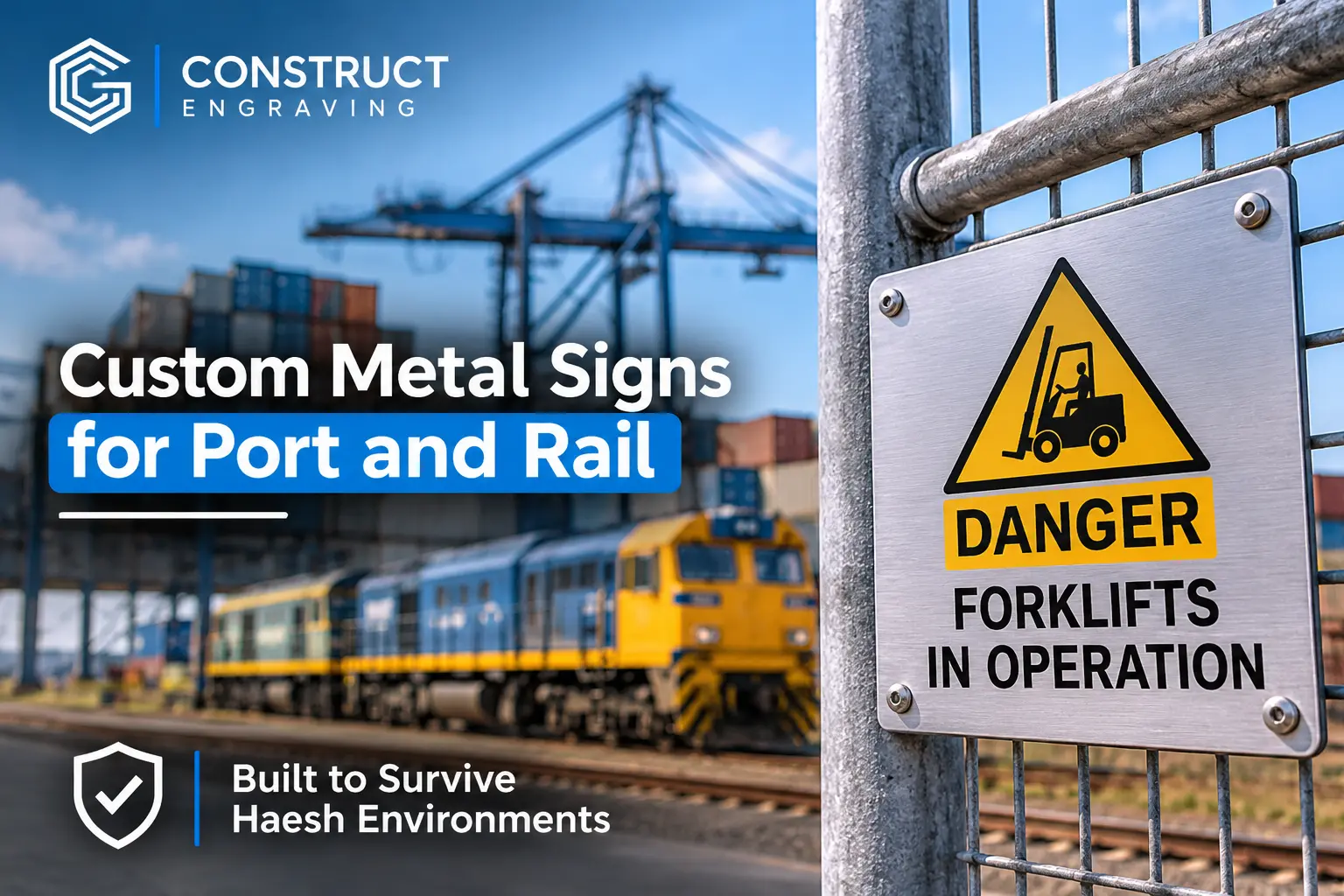
Custom Metal Signs for Port and Rail: Built to Survive Harsh Environments
Custom Metal Signs for Port and Rail: Built to Survive Harsh Environments
Walk through any port terminal or rail yard and you’ll see how exposed everything is. Salt air, diesel residue, red dust, summer heat and pressure washers all take their toll, and signage has a hard life in these places. A paper label or cheap plastic sign might look fine on day one, but it rarely survives a full season.
That’s why many operators now rely on custom metal signs and metal identification tags wherever clear identification matters. This guide explains why they last longer, which materials suit which conditions, and what to think about before ordering.
Why standard signage struggles at ports and rail sites
Coastal sites deal with salt spray that attacks coatings and cheap fixings. Rail environments add brake dust, grease and strong UV that fades printed text. Stickers peel, plastic turns brittle, and ink fades until a warning is just decoration.
The bigger issue is safety. When an isolation point, hazard warning or equipment label can’t be read, someone has to guess, and around moving machinery that’s how incidents happen. Readable signage is a safety control, not just an expense.
Why custom metal signs hold up
Metal doesn’t fade, peel or crack the way other materials do. Custom metal signs can also be made to suit the exact job: size, wording, hole layout and mounting method. A sign for a crane cabin has different needs from one on a signal cabinet or wharf fixture, so a one-size-fits-all product rarely works.
Three materials come up most often in port and rail work:
- Aluminium: lightweight and corrosion resistant, a good fit for warning signs and general site signage.
- 316 stainless steel: the usual choice for coastal and marine conditions, where salt exposure wears down lesser metals.
- Rowmark or Traffolyte: engraved laminate that suits panel labels and control cabinets, with a clean two-tone finish.
How the markings are made
The material is only half the story. The method used to mark it decides how long the text stays readable.
- Laser etching produces sharp, permanent marking that can’t be rubbed off.
- CNC routing with paint filling cuts the lettering into the surface and fills it with colour, which gives strong contrast for warnings.
- Diamond dragging creates fine, precise engraving, suited to smaller plates and detailed information.
Each method has its place. Deeper engraving generally suits outdoor, high-wear locations, while finer etching works well on small plates and indoor equipment.
Metal identification tags: the quiet workhorses
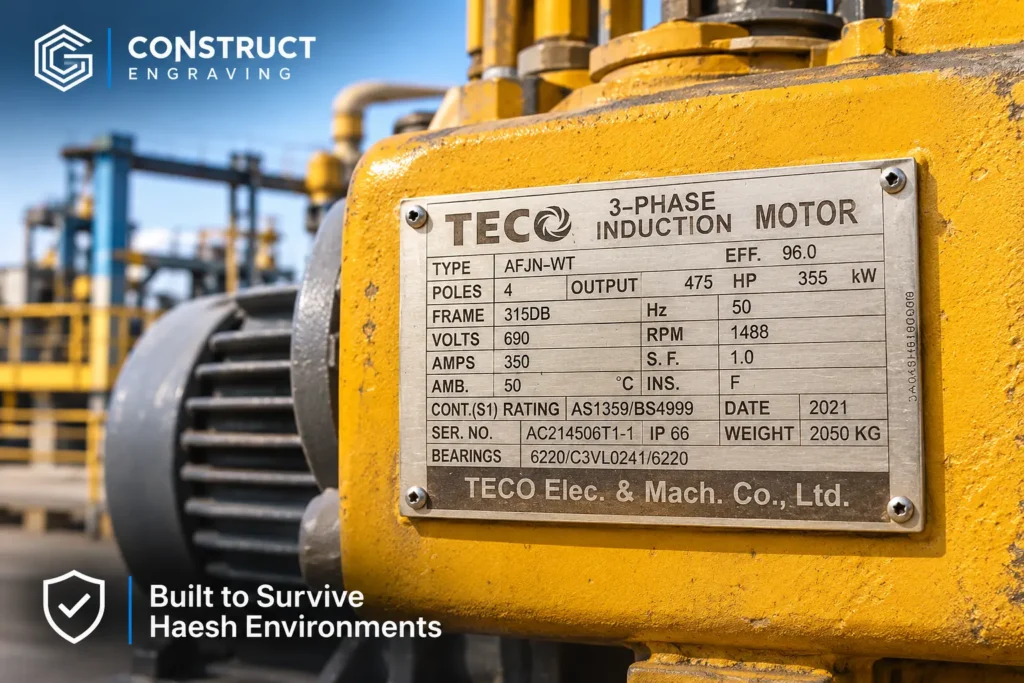
Signs get most of the attention, but metal identification tags do a lot of the daily work. They mark individual assets such as valves, switchgear, pumps, lifting gear, junction boxes and cable runs. When a maintenance crew arrives at a piece of equipment, the tag tells them what it is and how it fits into the wider system.
Paper tags and printed labels don’t survive washdowns, heat, handling and chemicals. Engraved or etched metal identification tags stay legible for the life of the asset. Many sites also add QR codes so a quick phone scan pulls up maintenance records, inspection dates or manuals.
For operations with hundreds or thousands of assets, a consistent tagging system also makes audits easier. Everything is numbered, everything can be found, and nothing depends on someone remembering which pump is which.
What to think about before you order
A little planning saves a lot of replacement costs later:
- Mounting location. Coastal, inland, undercover and fully exposed positions call for different materials.
- Reading distance. Text height, contrast, gloves and hi-vis gear all affect the design.
- Fixing method. Screws, rivets, cable ties and adhesive suit different surfaces, and drilling in the wrong place can be difficult on finished equipment.
- Site standards. Many operators have their own rules for colours, wording and layouts.
- Future orders. Keep the artwork and wording on file so replacements match what’s already installed.
Choosing signage that lasts
Port and rail environments will always be hard on equipment, and that includes the signs and tags attached to it. Durable custom metal signs and properly engraved metal identification tags keep people informed, assets traceable and replacement costs down. For sites that need either one made to order, Construct Engraving in Balcatta, Western Australia, supplies both for port, rail, mining and electrical applications.
Frequently Asked Questions
What are custom metal signs used for in port and rail?
They’re used for safety warnings, site and wayfinding signage, equipment identification and information plates on infrastructure and rolling stock.
Which metal is best for coastal sites?
316 stainless steel is generally the best choice for salt-heavy conditions. Aluminium works well inland and for many warning signs.
What information goes on metal identification tags?
Asset numbers, tag IDs, cable references, equipment names and QR codes are all common. Anything that needs to be traced or maintained can be engraved or etched.
How long do engraved metal signs last?
Much longer than printed or plastic alternatives. Lifespan depends on the environment and material, but engraved metal can often last the life of the asset.
Are metal identification tags better than printed labels?
For harsh environments, yes. Printed labels fade, peel and smudge, while engraved metal tags keep their markings through heat, moisture and cleaning.