
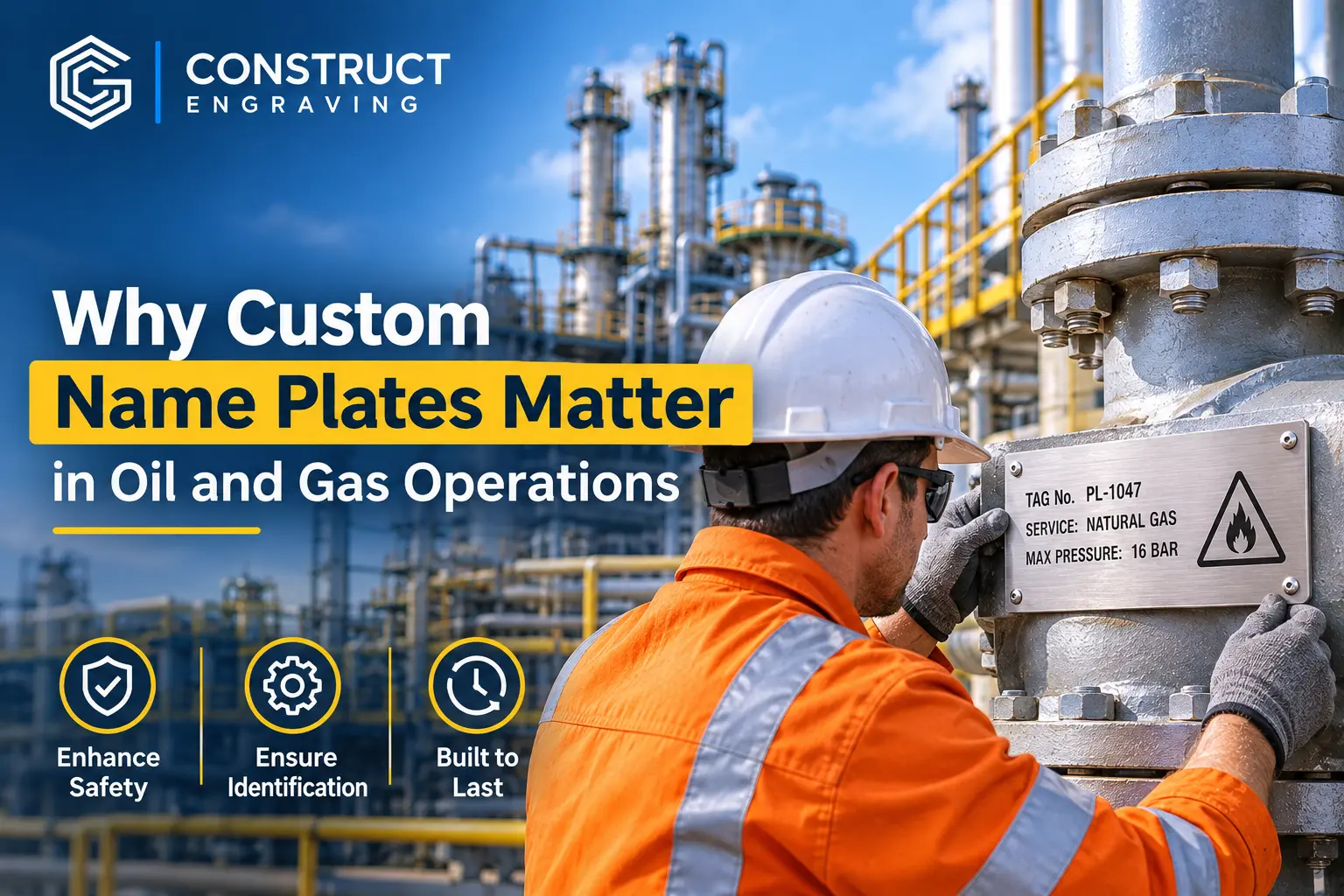
Why Custom Name Plates Matter in Oil and Gas Operations
Why Custom Name Plates Matter in Oil and Gas Operations
The right name plate keeps your equipment identifiable, your crews safe and your audits painless, even when salt, heat and chemicals do their worst. Get the material and the marking method right, and well-made custom name plates can last as long as the assets they’re fixed to. Get it wrong, and you end up re-labelling a facility every couple of years.
This guide covers what name plates actually do on an oil and gas site, which materials hold up, and where laser engraving services fit in.
What does a name plate do on an oil and gas site?
At its simplest, a name plate tells you what you’re looking at: a tag number, a description, a duty, a warning. Data plates add the technical detail, like ratings, serial numbers and manufacturer information. Together they save crews from hunting through drawings or asking whoever happens to remember.
It’s a safety issue too. Isolating the wrong line because a label was unreadable is a mistake nobody wants to explain afterwards. Clear identification helps people work on the right asset the first time.
Why do standard labels fail in this industry?
Heat, salt air, UV, chemical splashes, washdowns and constant vibration wear down anything fixed in place. A basic printed sticker can fade, curl or peel within months, and re-labelling a large facility is slow, costly work.
Custom name plates avoid that because you choose the material, size, fixing method and wording to suit the asset and its environment. They can also follow your own tagging format, so every plate matches your asset register from day one.
Which material should you choose?
There’s no single best option. It depends on where the plate is going and what it will face.
Stainless steel is the go-to for outdoor, coastal and corrosive areas. It copes with weather and chemicals and stays legible for years.
Aluminium is lighter and cost-effective, which suits panels, enclosures and equipment with less extreme exposure.
Traffolyte and Rowmark laminates are popular for switchboards, control panels and general equipment labels. They come in plenty of colours, so they also suit colour-coded identification.
Not sure? Tell your supplier where the plate will live and what it will be exposed to, and let them recommend from there.
How do laser engraving services make plates last longer?
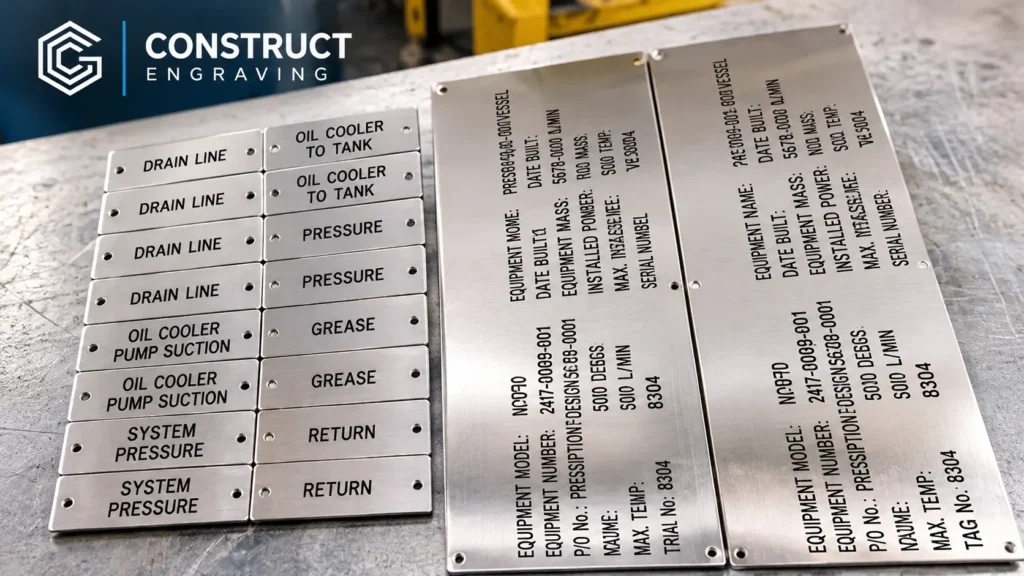
How the information gets onto the plate matters as much as the plate itself. Laser engraving services mark the material directly, so the text or graphic becomes part of the surface instead of something sitting on top of it. There’s no ink to fade and no coating to scratch off.
Lasers are also precise. They handle fine text, small serial numbers, logos and QR codes with clean, consistent edges, which is handy when a data plate has to carry a lot of information in a small space. It’s repeatable too: fifty identical plates, or a batch with sequential tag numbers, come out consistent every time.
Laser isn’t the only option. CNC routing with paint filling gives deep, high-contrast lettering that’s easy to read from a distance, and diamond dragging suits certain metals and finishes. A workshop that offers several techniques can match the method to the job instead of forcing every job through one process.
Five things to sort out before you order
- Match your asset register. Tag numbers on the plate should line up exactly with your documentation.
- Think about readability. Text that looks perfect on screen can be too small on a pipe two metres up. Size it for the person reading it.
- Plan the fixing method. Screws, rivets, adhesive or cable ties each suit different surfaces and conditions.
- Consider QR ID tags. A scannable code can link to maintenance records or manuals and save time in the field.
- Order spares. Plates get damaged during maintenance. Replacements on hand avoid last-minute rushes.
How do you choose a supplier you can rely on?
Look for real experience in industrial settings, someone who will talk through materials and methods and deliver on time. Ask to see examples of past work, and check they can handle both one-off tags and larger batches. Quality shows in the details: crisp lettering, accurate dimensions, clean edges and consistent finishes across a whole order.
Final thoughts
Name plates rarely get attention until something goes wrong, but they quietly support safe, efficient operations every day. The right material, the right marking method and the right supplier mean your equipment stays identifiable for years instead of months.
At Construct Engraving, we produce custom name plates, data plates, ID tags and labels for oil and gas clients, using laser engraving services and a range of other techniques to suit each project. Call us on +61 8 9344 4549 or email sales@construct.com.au for a free quote.
FAQ
How long do custom metal name plates last? It depends on the material and the exposure, but an engraved stainless steel plate can stay readable for many years because the marking is cut into the metal rather than printed on it.
Can a name plate carry a QR code? Yes. Laser engraving can mark QR codes that link to manuals, maintenance history or asset records.
What goes on a data plate? Usually a tag number, equipment description, serial number, ratings, manufacturer details and any safety warnings. Your site’s own requirements decide the exact layout.
What do I need to send for a quote? Your tag list or artwork, the material you have in mind, plate size, quantity and how the plates will be fixed. If you’re unsure on any of these, ask for advice.